Foxley Court Industrial — Solar Study Rollout

CLAIR modelled generation potential, shading, and grid export to determine which industrial roofs should receive solar first and what the real payback period would be.

Client

Centuria

Duration

Q1–Q2 2025

Focus

Solar Study & Digital Twin

Foxley Court Industrial - Solar Study

Overview

Foxley Court operates a large industrial warehouse in Derrimut, in Melbourne's west, a high-consumption logistics site with a huge amount of unused roof surface. The question wasn't "can we add solar," it was "how much should we add, where should it actually go, and what does that give us back?" Instead of commissioning a static desktop feasibility report, Foxley Court asked CLAIR to answer those questions inside their live digital twin of the asset.

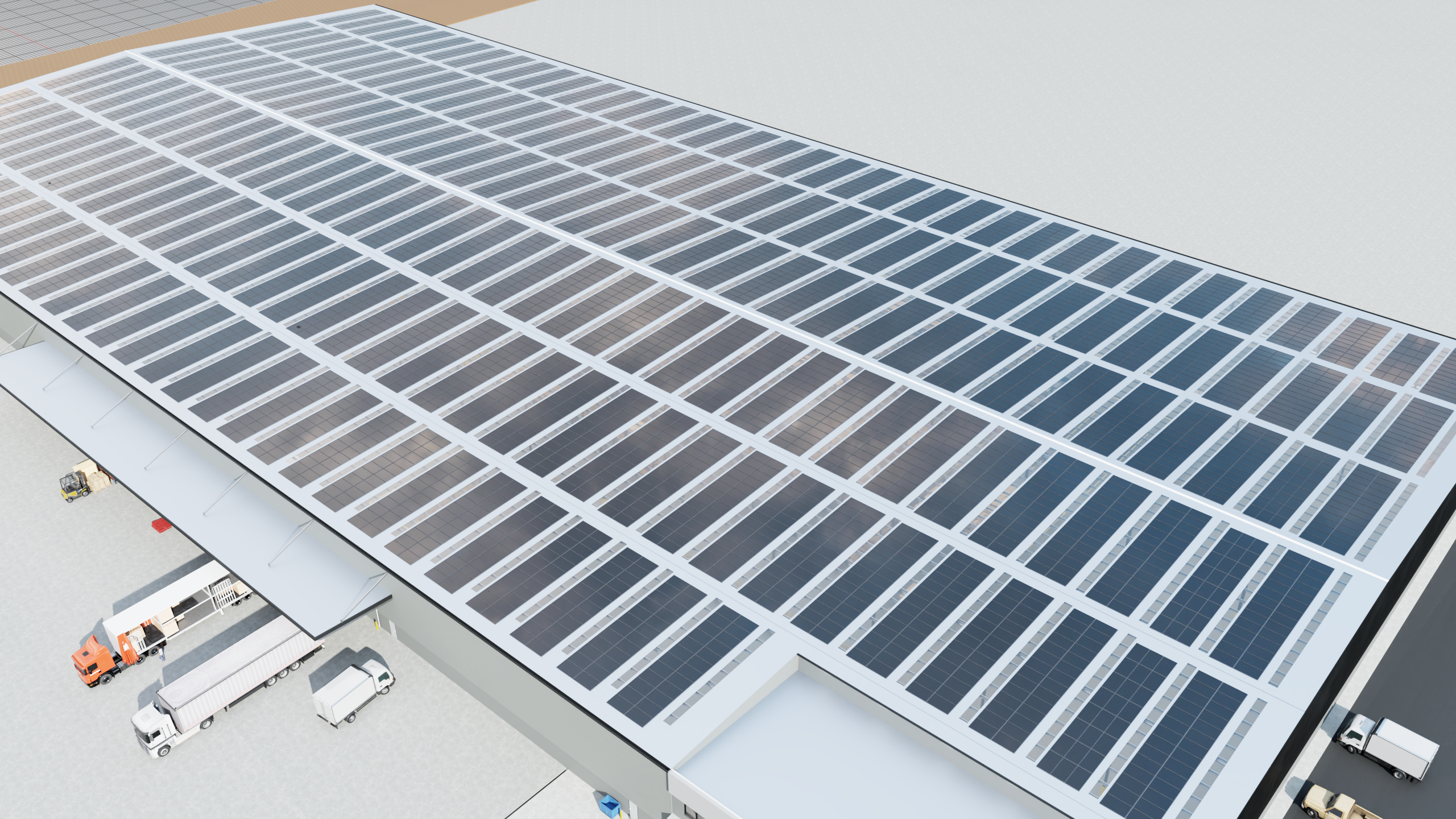
Using CLAIR's Solar Study, we placed digital solar arrays on the warehouse roof in 3D, iterating panel spacing, coverage, and orientation. Every scenario was stress-tested against the real roof geometry and sun path, and scored for projected generation. That let us identify the highest-yield zones first, quantify expected on-site offset, and build a staged rollout recommendation the finance team could actually sign off — all before a single physical panel was procured.
Challenge

The Foxley Court warehouse clearly had rooftop capacity but nobody had a defensible view of how to use it. Which roof zones were structurally and spatially suitable? How much load could solar realistically offset on-site? Was the right move a full install, or a staged rollout? The team needed numbers they could take to finance, not a generic "up to X% savings" promise.

Approach

We extended the site's CLAIR digital twin with Solar Study. That let us place digital panels on the real roof geometry, vary array density and orientation, and instantly forecast output against Melbourne sun path. From there we compared scenarios, isolated the highest-yield sections of roof, and packaged a staged installation path instead of a single all-or-nothing capex ask.

Outcomes

Optimal panel placement identified before physical install

Generation forecast tied to real roof geometry, not generic assumptions

Investment pack with staged rollout, making approval far easier

Timeline

Week 1–2

Site & Roof Capture

Ingested warehouse geometry, structural zones and usable roof surface into the digital twin.

Week 3–4

Solar Layout Simulation

Placed virtual panel arrays at different densities and orientations, modelling sun path and shadowing.

Week 5

Generation Forecast

Projected on-site generation and load offset for each candidate layout.

Week 6

Investment Pack

Staged rollout recommendation: which section first, expected yield, and the business case.

Capabilities Used

Digital Twin
Solar Study
Scene Enhancement

More case studies

All case studies